PCA 2026 General Assembly Report
Moderator Melton Duncan enabled the Assembly to overcome "Clickergate" and do far better than "OK," but to thrive and to work toward unity and love.

PCA Moderator RE Melton Duncan has gaveled the close of the 53rd General Assembly. If you read my update from Wednesday, you may recall I was optimistic we could have ended mid-afternoon. But alas, the search for “OK” on our voting clickers delayed our deliberations by hours. The Assembly’s Clerk pledged the Administrative Committee would find a more competent voting partner to use in the future.

Moderator Duncan was nonetheless able to maintain good humor and use his quick and winsome wit to keep the Assembly from being overwhelmed by frustration.
The Health of the PCA
The PCA continues to grow in prosperity, peace, and purity after a decade or more of a slide toward broad evangelicalism that culminated in the Revoice controversy. In a sense, Revoice was the best thing that happened to the PCA, because it woke up many elders and congregations who had adopted an attitude of indifference and apathy toward theological precision that culminated in a lack of involvement with the courts of the Church.
The renewed interest and participation in the church courts has been used by God to sharpen the PCA’s commitment to her theological heritage and revitalize her devotion to the Westminster Standards. Let me highlight three indicia of renewed health and vitality in the PCA.
Stated Clerk and Moderator
I wrote more about this on Wednesday, but we should not overlook the change that has taken place in the PCA since 2021.

The Assembly has continued her pattern of choosing her officers from men who signed the Dowling Dissent in the matter of Missouri Presbytery and Greg Johnson before the SJC. This crucial dissent highlighted troubles with the Judicial Commission that allowed the deviant Saint Louis Theology to find a temporary home within the PCA.
Both RE Melton Duncan (Moderator) and TE Fred Greco (Stated Clerk) were among the seven men who believed the initial investigation of Missouri Presbytery was clearly erroneous in its conclusions regarding Greg Johnson’s Christian character.
Now the denomination is led by three of the men who signed that dissent. In fact, only one of the men who joined RE Dowling’s dissent has not yet been elected GA Moderator.
Healthy Outreach and Discipleship
Reformed University Fellowship (RUF)
I was privileged to serve on the RUF Committee of Commissioners (CoC) and to review the work of the RUF permanent committee and staff over the last year. Although I (along with others) expressed concerns about some of the staffing decisions and other matters, I am remarkably encouraged by the work RUF is doing among college students.
Initially RUF was founded to pastor, shepherd, and disciple PCA college students, yet in recent years it has taken on the additional role of evangelism on university campuses. I suppose it was inevitable that discipleship would lead to evangelism. The Lord has been pleased to bless the widening mission of RUF, which began in 1975 with two campuses, but now includes more than 200 campus ministries 50 years later.
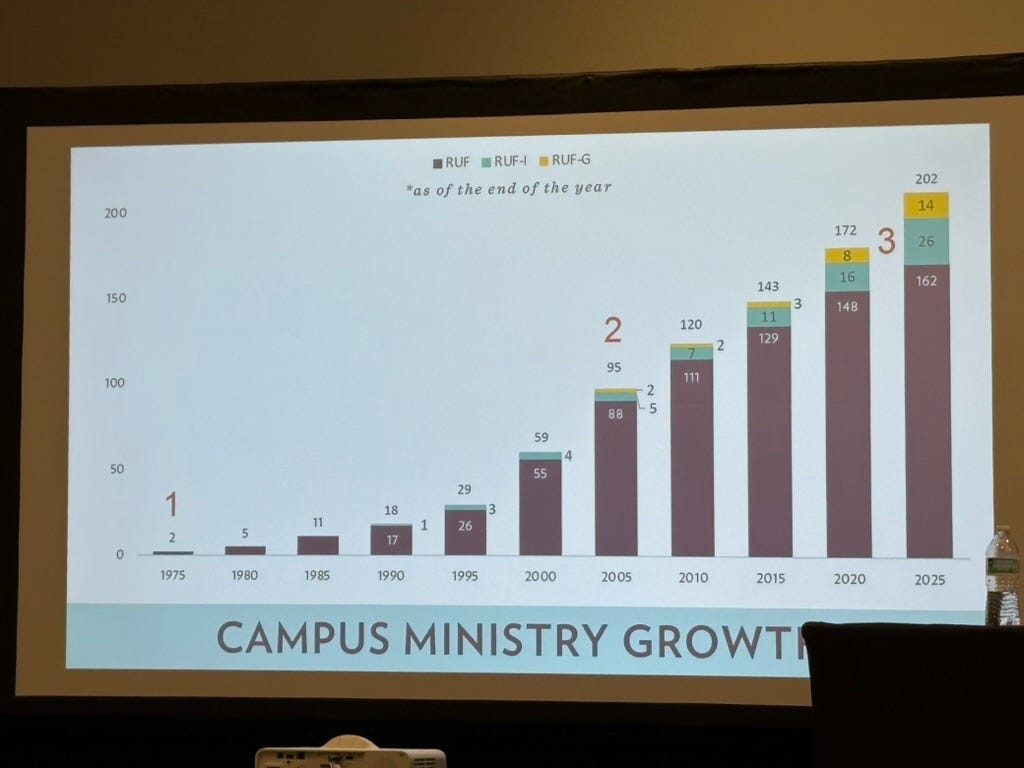
RUF not only ministers to American college students, but also to international college students in the US and has established several global campuses at universities abroad.
Church Planting & Mission to North America (MNA)
In recent years, MNA has been hindered by financial troubles and critical theory. Despite the drastic austerity efforts taken to correct the mismanagement of the previous MNA Coordinator, the PCA continues to plant hundreds of churches with dozens becoming particular congregations each year.
There is no denomination that plants more Reformed, confessional, Old School, ordinary means of grace congregations than the PCA. Sure, some plants are little more than cultural-preservation-community-garden–and-bead–necklace-making-non-profit-organizations that lead me to roll my eyes. But MNA is nonetheless facilitating many healthy, ordinary church plants around the country.
One striking token of the Lord’s blessing on PCA efforts at evangelism, discipleship, and church planting is the creation of two new Presbyteries. One centered around the Knoxville region and another centered around Arkansas. Arkansas has long been difficult soil for Reformed and Presbyterian ministries. But the Lord continues to supply the golden oil so that the light of Christ may go out from His Church so sinners may be brought to newness of life to the praise and glory of God our Saviour.
Superior Speeches this Year
I was impressed by most of the GA speeches this year. With very few exceptions, most speeches avoided the usual droning on about “brokenness” and wondering “how did we get here” emotionalism. Most of the speeches addressed the question(s) at hand and presented focused, biblical, theological, and constitutional arguments.
Please note: I have deleted a paragraph related to abuse of the “point of personal privilege” from this year’s GA report. It’s probably a quixotic quest at this time. But if you ask me about it, I’ll tell you. So don’t ask.
Changes to the PCA Constitution
The Benefits of an Improving Constitution
I have heard criticism of the PCA’s BCO binder. Some of our sister communions change their operations and procedure manuals far less frequently than does the PCA. (e.g. the OPC only changes their BCO every five years). This has led to the assertion the PCA is more focused on procedure and constitutional debates than the weighty matters of the Great Commission.
I understand the criticism. But what we have seen is the PCA advances from strength to strength with its improving Constitution. The PCA is not distracted by polity debates, but the decency, good order, and the PCA’s continually improving procedures have created a culture of zeal for discipleship and evangelism, church planting and shepherding. This is exactly what we should expect since our God is a God of order and peace.
Certainly, bad ideas are proposed each year because our Constitution is amendable. Men in obnoxiously fancy socks seem to have a knack for sending up bad ideas.
This year the Assembly ratified numerous amendments and sent down several proposed changes to its procedures. The Assembly also rejected quite a few. These small changes annually reflect a denomination that is healthy, growing, and continually looking for ways to improve its biblical polity as it encounters and overcomes challenges.
Suspending an Accused
Despite the objections of elders from Central Florida Presbytery, the Assembly ratified an amendment that protects the right of an accused officer from being administratively suspended prior to trial and the opportunity to confront his accusers.
The “Abuse Industrial Complex” in the wider society has influenced a number of our colleagues in the PCA, with the consequence of some judicial commissions moving to suspend an accused person solely on the basis of the severity of an indictment and hearing a man plead not guilty. This is contrary to the general principles of the Scripture which afford an accused person the right to a trial.
The Assembly wisely preserved the right of a full presbytery or session to do so by a supermajority, which would be appropriate if a case is so well-known, scandalous, or apparent as to warrant informing the whole court rather than confining the matter to a judicial commission.
It seems the opposition to this amendment (now ratified) comes solely from pragmatic concerns regarding one particular case in one particular presbytery. But the principles reflected in the amendment are so obviously biblical, the opposition to it is troubling.
Reporting Officers
One of the hot-button issues in the PCA in the last year has been so-called “Functional Female Officers.” Recent efforts by men outside the PCA have called attention to the problem of some PCA congregations seemingly entrusting spiritual authority to unordained people. Where this is being done, it is a flagrant violation of God’s law and the PCA Constitution.
The difficulty is that many in favor of women’s ordination and/or women possessing spiritual authority typically prefer to conduct their operations in “conditions of low visibility,” and find loopholes and workarounds to the PCA Constitution.
In recent years, the PCA has strengthened her Constitution to specify that the titles of ordained office may be conferred upon only ordained men. The trouble with that is Sessions are still free to invent made-up titles (e.g. Deaconess, Shepherdess, Countess), which give the appearance of spiritual authority to unordained people.
The Assembly declined to take any action on this matter directly; you can’t legislate against such innovation. One PCA minister observed this a century ago:
Clear-cut definition of terms in religious matters, bold facing of the logical implications of religious views, is by many persons regarded as an impious proceeding.
Instead, the Assembly approved an amendment from Ascension Presbytery that - if ratified - will require congregations to list the members of their Session and Diaconate in their minutes. This will enable presbyteries to see which congregations have declined to ordain a diaconate as well as know who are the officers of the church. It will also add light on the debate regarding officers. As that PCA minister from a century ago noted: “Light may seem at times to be an impertinent intruder, but it is always beneficial in the end.”1
I would have liked to see the Assembly take additional action to strengthen our polity along the lines of what Missippi Valley Presbytery proposed in Overture 52. But the Overtures Committee wisely observed our Constitution provides ample mechanisms to confront Sessions and officers that are flouting our rules. BCO 31-2 and BCO 40-5 exist for this reason. Just this year, the Assembly affirmed that Sessions dispensing the pretended title of deaconess is an apparent violation of the PCA Constitution; this is how BCO 40-1 and BCO 40-2 function.
Using the Constitution to bring conformity is difficult, but this is the way.

Terms for Coordinators
Two presbyteries sent overtures asking the Assembly to grant four-year terms to the coordinators of GA Committees and the Stated Clerk. This was wisely voted down. The PCA is unique in its practice of one-year terms for denominational leadership. This is because our agency leadership are administrative officers rather than ministry executives.
Interestingly, both the man presenting the Overtures Committee recommendation (to approve four-year terms) and the minority report (against four-year terms) are academic officers with one-year employment contracts and annual attestation of subscription to the Westminster Standards.
Nominating Committee (NomCom)
The biggest disappointment of the Assembly was the NomCom report. Only one floor nominee was elected. The broader-wing seemed to dominate this year’s NomCom meeting and the Assembly continued to defer to her committees.
This is not to say, however, that every man elected to serve was a progressive. But the removal of TE Art Sartorius from the SJC was a great loss.
This highlights the importance of being Presbyterians more than one week a year. Men need to be willing to make the sacrifice to participate in Presbytery meetings and to fight to serve on the Assembly’s committees such as RPR and NomCom, since the Assembly gives such deference to her committees.
The gains made through constitutional changes and RPR’s review and control will not be meaningful if there is no strong judicial commission to which trouble in the presbyteries may be referred.
Women Deacons Resoundingly Rejected
Despite an impassioned, though temperate, speech appealing to the Greek by the overture’s author, the Assembly overwhelmingly declined to change the Constitution to allow for women’s ordination. This surprised no one except maybe some Anons in Ogden or Moscow who are convinced the Baptist Rachel den Hollander is secretly running the PCA.
A dissent has been submitted that appeals to arguments already rejected by other Reformed Communions. The Moderator has appointed a commission to answer this dissent, which we await with eagerness.
Danvers Statement
One last item merits mention: the PCA declared the Danvers Statement (1987) to be biblically faithful and commended it for study and for the PCA Bookstore’s distribution. The Danvers Statement affirms historic, biblical roles for men and women. Men are called to leadership and “humble headship” in the home and church; women are called to joyful submission.
I believe it is risky to try to obtain the Assembly’s affirmations of outside documents (e.g. the RPCNA Sexuality Report, Nashville Statement), because a lack of affirmation may lead some Anons in Ogden or Moscow to think the PCA is repudiating the contents, which would be an uncharitable and inaccurate reading. Yet in this case, the Assembly commended and approved of the Danvers Statement.
The Statement was not “adopted” by the Assembly to force all officers to subscribe to its affirmations, but it was nonetheless recognized by the Assembly as giving a faithful summary of the Bible’s teachings and relevant for our cultural moment.
Conclusion
It is clear the efforts of the Old School wing of the PCA to clean house, sharpen our theology, and clarify our constitution are bearing fruit. Progressives and feminists in the PCA are showing an increasing discomfort and sending up overtures attempting to restore their lost latitude. Their efforts are not succeeding.
The debate at General Assembly is no longer about how much an officer may talk about his base lusts, but rather issues of evangelism, discipleship, the sacraments, the glory of Christ, and the peace, purity, unity, and prosperity of His Church.
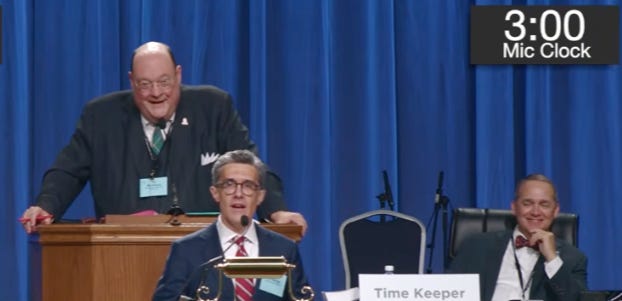
Well done, brothers. Thank you, Mel Duncan and Guy Waters for your leadership.
J. Gresham Machen, Christianity and Liberalism, “Introduction.” Machen died in the Presbyterian Church of America. He was a Southerner. He belongs to the PCA.